- calendar_today August 10, 2025
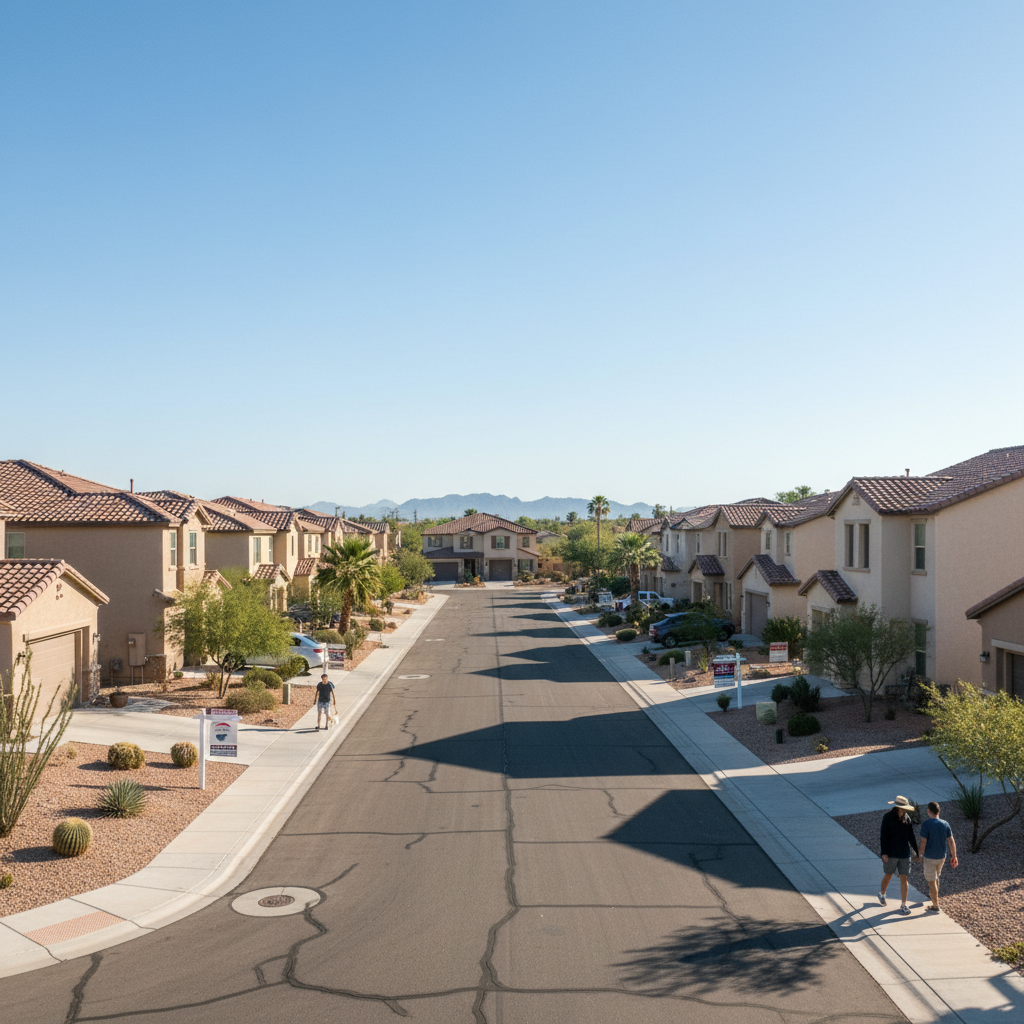
After nearly a decade of rapid growth, Arizona’s housing market is entering a clear period of stagnation. Once defined by sky-high demand and record-setting prices, the Grand Canyon State now finds itself in the middle of a widespread housing market freeze.
In Phoenix, the state’s economic engine and fastest-growing metro, home sales have dropped 22% year-over-year, according to the Arizona Regional Multiple Listing Service. Meanwhile, once-hot areas like Scottsdale, Tucson, and Flagstaff are seeing extended days on market and more price cuts than at any point since 2020.
“We’re seeing more listings sit, fewer bidding wars, and increased seller concessions,” said Angela Montoya, a broker in Tempe. “It’s a complete shift from what we were dealing with just two years ago.”
Interest Rates Keep Buyers on the Sidelines
While inflation has moderated in 2025, mortgage rates have remained stubbornly high, averaging around 6.6% for a 30-year fixed loan. This has placed enormous strain on affordability in Arizona—especially in Maricopa and Pima counties, where prices have remained elevated.
For many first-time buyers, the increased monthly payments—often $500–$800 more than what the same home cost in 2021—have become a dealbreaker.
“We’ve got pre-approved buyers just waiting, hoping for either a rate drop or a price correction,” said Ramon Perez, a mortgage broker in Glendale. “In the meantime, listings are sitting.”
Out-of-State Migration Slows Down
Arizona’s population surged between 2018 and 2022 as residents from California, Washington, and the Midwest relocated in search of more affordable housing and warmer weather. But that migration has slowed dramatically in 2025.
According to the latest U.S. Census Bureau data, Arizona’s net inbound migration has dropped by over 30% since its 2021 peak. The combination of higher home prices, rising insurance premiums, and concerns over water availability have caused some prospective newcomers to reconsider.
“Arizona used to be the place to go when California got too expensive,” said Sofia Nash, a relocation consultant in Chandler. “Now, it’s becoming expensive in its own right.”
A Glut of Investor-Owned Properties
Between 2020 and 2023, institutional investors snapped up thousands of single-family homes across Phoenix, Mesa, and other high-growth areas. Many of those homes are now back on the market as rental demand softens and property maintenance costs rise.
As a result, the market is experiencing a backlog of investor-owned homes—many of which were never occupied—flooding the listings with supply that isn’t moving.
“Investors are offloading inventory at a time when the buyer pool is shrinking,” said real estate analyst Brian Cutter in Scottsdale. “That imbalance is contributing to the freeze.”
Affordability Crisis Still Unresolved
Even though price appreciation has slowed, housing affordability in Arizona remains a persistent issue. The Arizona Housing Affordability Index—published quarterly by ASU—shows the typical household can no longer afford the median-priced home without taking on unsustainable debt.
In Phoenix, the median home price is still hovering around $455,000, while in Flagstaff and Sedona, prices often exceed $600,000, pricing out both locals and retirees.
“This freeze isn’t because homes are cheap now—it’s because they’re still too expensive for most people,” said Dr. Kayla Rees, a housing policy expert at Arizona State University.
Northern Arizona and Rural Areas Show Mixed Trends
While urban and suburban markets are stalling, parts of Northern Arizona and rural regions like Payson, Show Low, and Prescott are experiencing more nuanced conditions.
Some buyers from out-of-state are still purchasing second homes in mountain towns, and retirees continue to be drawn to scenic and relatively quiet communities. However, activity in these regions is also slowing as cash buyers become more cautious and rental income potential declines.
“Vacation home buyers aren’t moving with the same urgency anymore,” said Jeff Alvarez, a broker in Prescott. “And locals have been priced out for years.”
Builders Pull Back Amid Rising Costs
New home construction, which had exploded in areas like Goodyear, Surprise, and Marana, is starting to pull back. Builders are grappling with tighter lending conditions, higher material costs, and concerns about unsold inventory.
Permits for new single-family homes have dropped 18% year-over-year statewide, according to the Arizona Department of Housing.
“We’ve paused new developments until demand stabilizes,” said Monica Liu, a project manager at a regional homebuilder in Tucson. “We don’t want to be left with homes we can’t sell.”
Insurance, Climate, and Water Drive Buyer Hesitation
Another factor unique to Arizona is the increasing role that climate risk and insurance play in buyer decisions. Home insurance premiums have jumped in wildfire-prone areas and in regions where drought threatens long-term livability.
Concerns about long-term water access, particularly in the Phoenix metro, are also weighing on buyers. New state-level rules governing groundwater use and well drilling have made some land purchases more complex or less viable.
“We’re hearing questions about water security in nearly every buyer consultation,” said Susan Carroll, a Flagstaff agent. “That didn’t happen five years ago.”
The Outlook for Sellers and Buyers
In this frozen market, both buyers and sellers are adjusting their expectations.
For sellers, overpriced listings are languishing. Those who need to sell are being advised to offer incentives like interest rate buy-downs or closing cost coverage. Strategic pricing is once again essential.
Buyers, on the other hand, have more negotiating power—but they’re also being far more selective. Contingencies are back, home inspections are no longer being waived, and many are waiting for clearer signs of market stability before making offers.
“It’s not a buyer’s market in the traditional sense, but it’s definitely no longer a seller’s market,” said Elijah Grant, a realtor in Mesa.
Arizona’s Market: A Cooling Phase, Not a Crash
Despite the slowdown, most experts don’t expect a full-scale crash in Arizona. Instead, 2025 is shaping up to be a necessary cooling period after years of overheated growth.
Price corrections are expected to remain mild, with the Arizona Department of Real Estate forecasting a 2%–5% dip in median home values by the end of the year. But that correction may be exactly what the market needs to restore balance.
“We’re hitting pause—not panic,” said Dr. Rees. “This is a correction, not a collapse.”