- calendar_today August 28, 2025
The Traditional Symbols Hidden in KPop Demon Hunters
KPop Demon Hunters has become a mainstream Netflix success story, skyrocketing to the top of international streaming lists since its release in June. While chart-topping films and K-pop listeners are often separate groups, in this case, the audiences overlap considerably. The animated film has been streamed more than 33 million times in two weeks and made it into the global top 10 in 93 countries, ranking second overall at the moment. Fans have started creating their drawings and are calling for a sequel almost every day.
Music acts are sharing in this success: since the film’s premiere on 20 June, the two fictional groups featured in the story – virtuous all-girl group Huntr/x and their evil rivals Saja Boys – have been climbing the real-world music charts, overtaking superstars BTS and Blackpink. Seven songs from the film appear on Billboard’s Hot 100, while in the US Spotify rankings, they took first and second place, positions which the Billboard chart editor considered an “oddity” since they are held by non-existent groups. On the digital music streaming site, the seven songs have also overtaken all BTS, BLACKPINK, and Seventeen songs released in 2023.
KPop Demon Hunters is a superhero fantasy adventure with a backdrop of Korean pop, in which the three Huntr/x – Rumi (Anessa Ramsey), Mira (Jessica Rivera), and Zoey (Francesca Gregg) – live double lives as global pop stars and demon hunters. Their rivalry with the all-boys group Saja Boys is only one part of the action: dazzling dance moves on the K-pop stage, slick battles with evil, and a story about friendship and trust, learning to embrace who you are and not being afraid to show it. In the end, the special blend of humour, emotion, and fantasy found a wide audience.
Visually and narratively, the film gives an intriguing introduction to the world of K-pop, but it is the music that made it a true phenomenon. Maggie Kang, one of the film’s co-directors, said she got the idea from K-pop idols she followed in her youth. In addition to the visual and emotional aspect, music in the film has a more direct function: because their powers are activated by the demonic threat, Huntr/x uses it to fight evil — and, as music critic Lauren Michele Jackson writes in the New York Times, “the incorporation is so seamless that it never interrupts the forward momentum of the story”. Co-director Chris Appelhans explains in an interview with Netflix that this is due to the unique style and details with which the movie’s music had to be created. Co-producer Lashai Ben Salmi, a European community leader with an interest in Korean music and culture, says this approach makes the film stand out. “It gives the film a surprising level of maturity.”
In this pursuit of perfection, the two filmmakers worked with a Korean label and some of the most successful names in the industry. Teddy Park, who rose to fame with 2 PM and Blackpink, and Grammy Award-winning Lindgren, known for hits with BTS and TWICE, created seven original songs that sound like mainstream K-pop hits. “I am by no means a K-pop stan, but it has had me hooked since the first trailer,” Amanda Golka, a Los Angeles content creator and web editor, admitted in an interview. “I have been blasting the soundtrack from Spotify every time I’m in the car. It’s fascinating how music can be such a universal language.”
Authenticity is also true for the local culture and lifestyle. While Korean pop, films, and dramas have already gone mainstream in the United States and other Western countries, KPop Demon Hunters takes it to a new level. The details of everyday Korean life are constantly woven into the story, from food and traditional ways of eating to the filming of Korean capital scenes like ancient city walls, healing clinics, Hanuiwon, bathhouses, and Namsan Tower. Some decisions may seem cliché to foreigners, but for Korean viewers,, they break with stereotypes to show local culture and daily life respectfully and authentically.
The production team visited South Korea and captured the scenes up close. They recorded folk villages, photographed city streets in Myeongdong, and researched traditional clothing. Authenticity can even be seen in the animation: although the characters speak English in the finished film, the movements of their mouths reflect Korean pronunciation, and their facial expressions and gestures are typical of Koreans. In some parts of the film, you can also hear Korean words or song lyrics, and this attention to detail makes the story feel more familiar and close.
Fans also notice how well the reality of K-pop fandom was reflected in the film: from fan signing to the shimmer of multicoloured light sticks, from Kalgunmu (perfectly synchronised dance routines) to Korean fan signs, the picture turns out to be realistic. The scope of the K-pop culture is so great that it includes all generations and eras. In KPop Demon Hunters, the filmmakers focused not on a specific group, but on K-pop in general, which made it more accessible for viewers unfamiliar with it, and for K-pop fans, they filled the plot with detailed references.
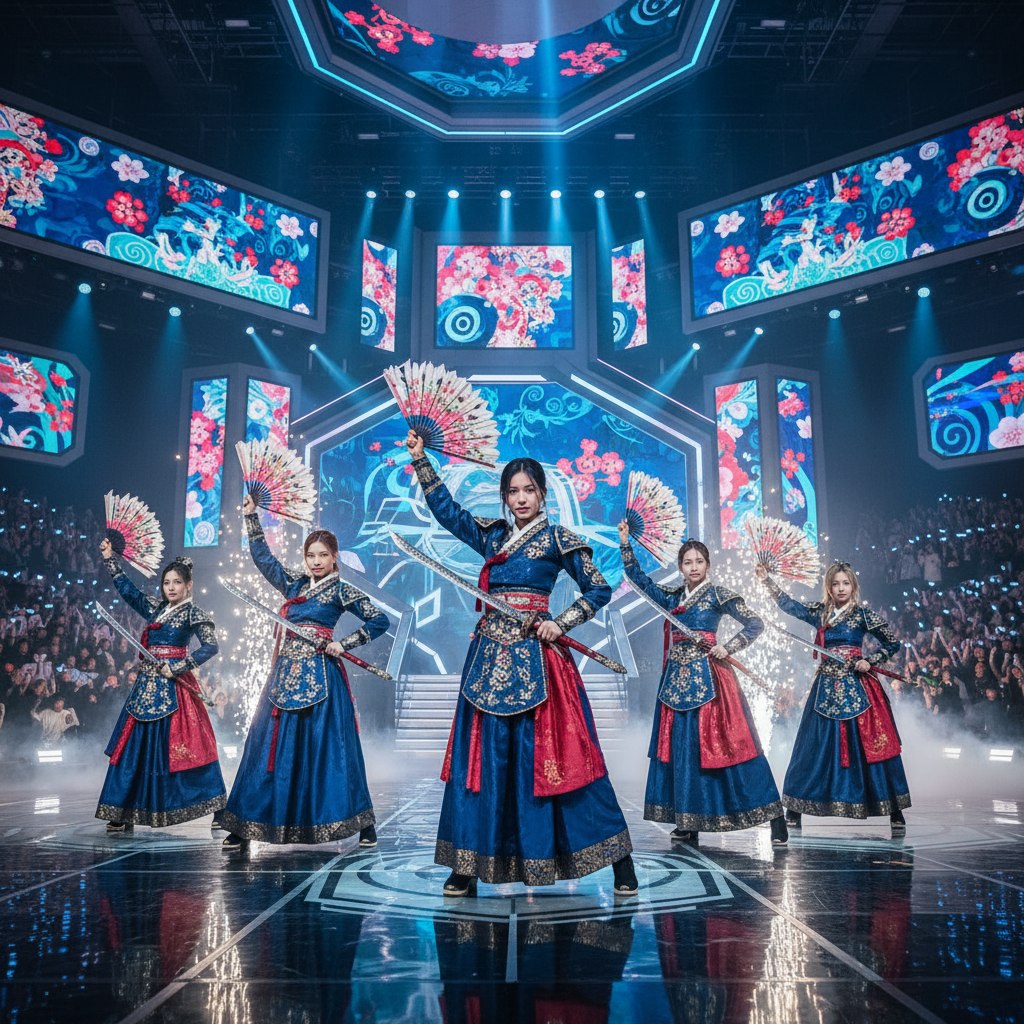
They also brought in some traditional Korean folklore into the fantasy action, imbuing the characters’ costumes with local features and using symbols known from Korean tales. For example, Huntr/x use swords and fans in their fights — weapons that resemble those of the Mudang, Korean shamans. The Saja Boys, meanwhile, are depicted in ways similar to the Korean Grim Reaper. Traditional Korean symbols are found throughout the film, including Dangsan trees and Dokkaebi goblins. Folklore even inspired the characters’ team mascots: Derpy the tiger and Sussy the magpie, guardian spirits and a symbol of good fortune.