- calendar_today August 7, 2025
Desert Roots, Digital Tools: How Arizona Artists Are Using AI Without Losing Their Identity
Arizona Artists Are Open—But Not Letting Go
Arizona’s creative spirit is wide and deep—like the land itself. From the bold murals of Tucson to quiet studios in Sedona, this state has long been home to storytellers who blend tradition with rebellion. So when AI in creative work came knocking, Arizona artists didn’t reject it—but they didn’t rush in, either.
“I tested out a melody generator once,” a musician in Tempe told me. “It didn’t write the song, but it gave me a rhythm I ran with. Then I added the feeling.” For many here, AI in music is more like a spark—it lights something, but the fire still comes from the artist.
Filmmakers Are Using AI to Make Time for What Matters
Arizona’s film scene has grit. You’ll find indie films being shot in downtown Mesa, desert documentaries in Yuma, and student-led projects in Flagstaff. Most of these are made on tight budgets with even tighter schedules, which is why many creators are turning to AI in filmmaking to help handle the backend.
One director I spoke with in Phoenix said, “AI helped organize our raw interviews and group visual themes. It didn’t touch the emotion—but it let us spend more time on it.” That’s key here. Time saved isn’t used to do less—it’s used to go deeper.
In the Studio, Artists Are Using AI with Intention
There’s something tactile about Arizona art. You can see it in the brush strokes, the handmade jewelry, the earth-toned palettes. So it’s no surprise that most artists using AI in visual art are doing so during the ideation phase—not to finish a piece, but to explore one.
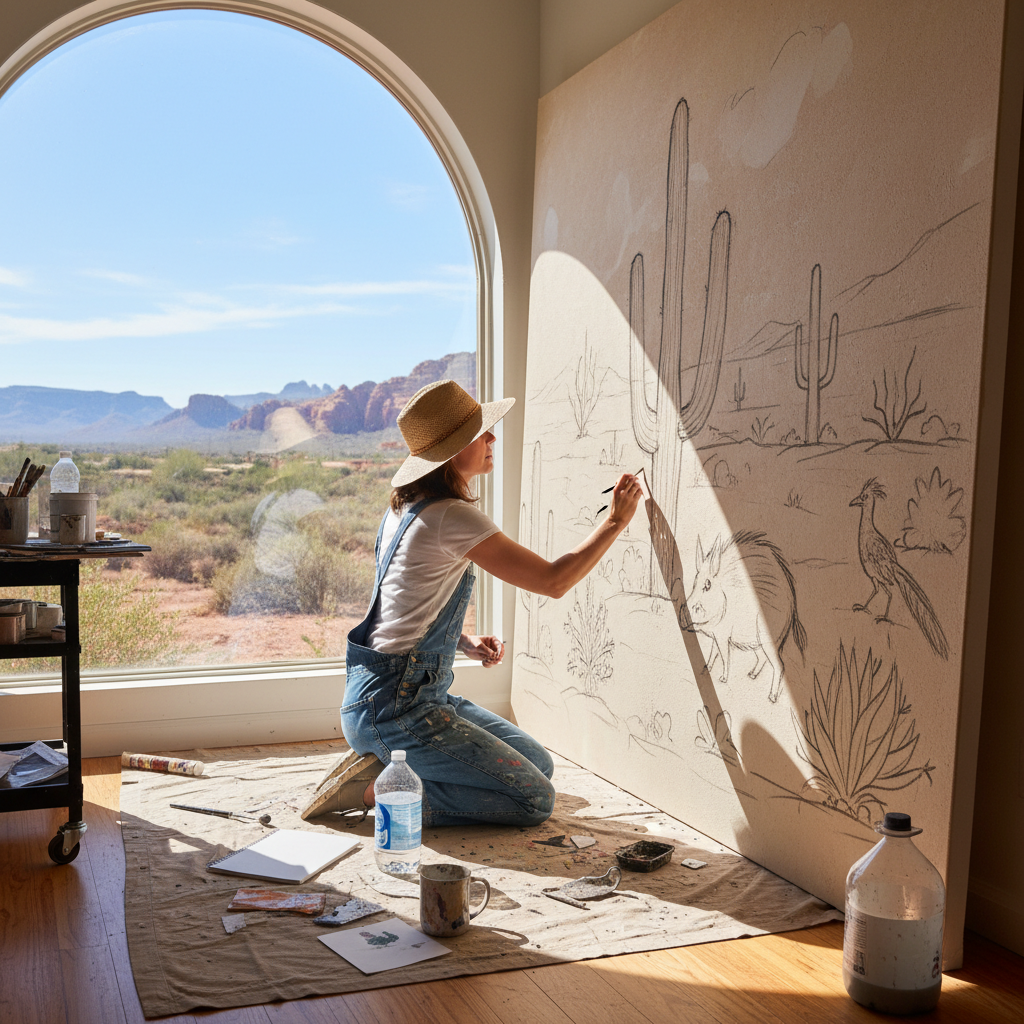
A muralist in South Tucson said, “I’ll generate a few layout options through AI before sketching by hand. It helps me see things differently—but the design still has to reflect this place, these people.” That grounded approach runs deep in the art here.
Young Creators Are Bringing Code and Culture Together
At schools like Arizona State, U of A, and local art colleges, students are playing with creative tech in Arizona in thoughtful, unexpected ways. From interactive storytelling exhibits to sound-reactive visual art, they’re proving that tech doesn’t have to replace meaning—it can amplify it.
A student in Flagstaff created an AI-powered poetry experience based on Indigenous oral history. “I worked with elders to make sure it honored the stories,” they said. “AI was just the shell—we filled it with what mattered.” That kind of care defines this next generation of creators.
Skepticism Still Has a Voice—and That’s Healthy
Not everyone is jumping in. In fact, many artists across Arizona are still choosing to work with their hands, their instruments, and their own intuition. A potter in Prescott told me, “I like the slowness of what I do. The mistakes, the textures. AI doesn’t belong in that.” And here, saying no to tech doesn’t mean saying no to progress—it means staying true to your process.
How Arizona Artists Are Actually Using AI
• To brainstorm faster – Artists use AI to test ideas or layout concepts
• To streamline editing – Filmmakers and musicians use it for organizing footage or sound
• To support storytelling – AI offers structure, but the heart of the story stays personal
• To explore—not finalize – Final creative decisions always come from the artist
Final Thoughts
Arizona’s creative landscape is as diverse as its geography—sprawling, textured, and rooted in lived experience. As AI tools start to show up in studios, editing rooms, and classrooms, artists across the state are figuring out how to use them without losing what makes their work theirs.
Some are excited. Some are skeptical. Most are somewhere in between—curious but careful. And that seems just right. Because in Arizona, the future may be digital, but the art still comes from something deeply human.