- calendar_today August 7, 2025
At a Shenzhen charging station you can gain enough power to drive from Los Angeles to San Diego while you grab your coffee. BYD, a leading EV manufacturer from China, has developed its groundbreaking “super e-platform” system which makes this fast charging vision a living reality. They’ve thrown down the gauntlet, declaring war on the EV’s Achilles’ heel: the agonizing wait for a full battery.
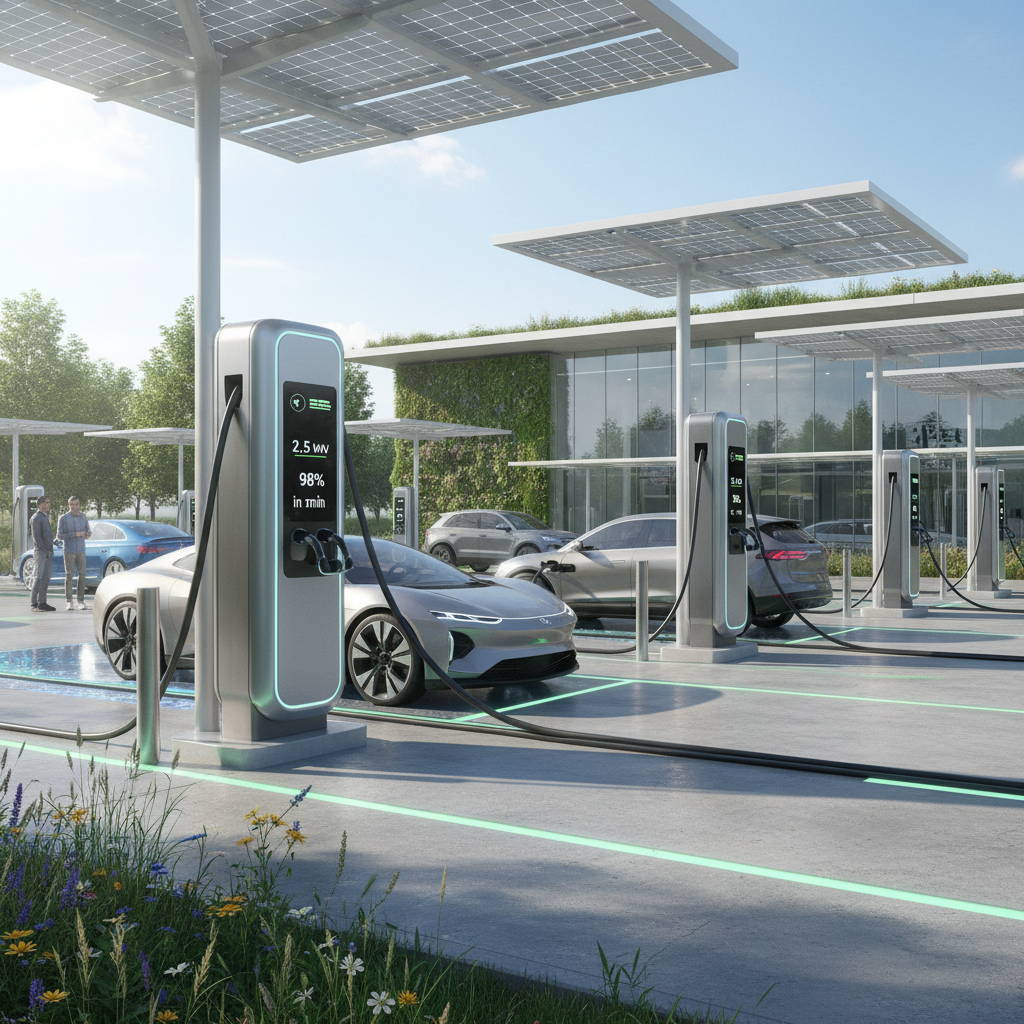
The slow progress of existing charging standards no longer holds relevance. BYD’s innovative system combines powerful 10C charging with 1,000 kW DC chargers to supply vehicles with 249 miles (400 km) of range in just five minutes. The innovation represents a quantum leap rather than a mere incremental betterment. Tesla’s Superchargers stand alone at 250 kW despite being the standard because both Electrify America and Formula E chargers cannot keep pace.
BYD chairperson Wang Chuanfu declares “We’re rewriting the rules” while transforming EV charging into a brief stop that rivals the speed of filling up a traditional gasoline vehicle.
Unlocking the Power: The 10C Symphony and Megawatt Surge
BYD’s revolutionary 10C charging capability transforms battery technology by achieving energy absorption rates previously believed to be impossible. The system achieves rapid energy conversion into vehicle distance when combined with 1,000 kW chargers to produce a smooth integration of power. BYD’s vision is bold: The company intends to establish more than 4,000 high-powered charging points throughout China to serve its top models, the Han L sedan and Tang L SUV. Automakers have designed these vehicles to maximize the benefits of high-speed charging technology which provides EV drivers with unmatched convenience.
The implications of this progress reach further than simply decreasing how long vehicles need to charge. This initiative marks an important advancement in removing range anxiety while establishing electric vehicles as viable options for daily transportation. Expanded charging infrastructure will allow consumers to make road trips without scheduling lengthy stops or waiting for chargers to open up. Through its substantial investment in infrastructure BYD creates a foundation that enables EVs to integrate smoothly into daily life while accelerating electric mobility and positioning it to directly compete with gasoline-powered vehicles.
The Global Chessboard: US Barriers and the Licensing Gambit
China launches its electrified revolution preparations while the US continues its struggle over political maneuvering. Congressional barriers prevent BYD and Chinese EV companies from accessing the American market by citing national security and economic risks.
BYD’s technological advances continue to captivate interest despite various market barriers. The 249-mile range measurement relies on China’s expansive CLTC standards yet suggests that range anxiety could become a thing of the past. Licensing BYD’s technology to US automakers presents a strategic opportunity to unite political factions while accelerating American electric vehicle adoption.
Beyond the Numbers: The Real-World Electric Dance
One thousand kW delivers undeniable power but achieving the right balance between kilowatts and kilometers remains intricate. Charging speeds in real-world situations depend on variables such as battery temperature conditions and charging infrastructure strength along with the current state of battery charge. The conversion of electrons into actual driving range depends heavily on vehicle efficiency which is expressed in km/kWh.
BYD’s “super e-platform” goes beyond faster charging because it redefines how people perceive electric vehicles. The strategy transforms what seems like a delay into a brief stop which demonstrates how electric innovation continues to advance. The electric revolution has arrived with BYD spearheading the transition.