- calendar_today August 14, 2025
Arizona’s real estate market in 2025 remains one of the most dynamic in the Southwest. With stabilizing interest rates and strong population growth, investors across Phoenix, Tucson, and secondary cities like Flagstaff and Mesa are reassessing their strategies. The focus is shifting toward income reliability, growth corridors, and long-term demographic trends fueled by migration and tech-sector expansion.
What types of properties are gaining traction in Arizona? Seven sectors continue to show resilience and adaptation, making them prime targets for investors looking to balance growth with stability.
Multifamily Housing: The Reliable Performer
Multifamily housing remains a reliable investment across Arizona. High mortgage rates and population influx have kept rental demand high, especially in the Phoenix metro area, where CBRE reports vacancy rates under 5%. In Tucson, mid-tier apartments in areas like Oro Valley and Catalina Foothills continue to attract long-term renters.
Class B and C properties in cities like Mesa, Glendale, and Tempe are thriving. Build-to-rent communities are booming as well, offering affordability and flexibility to residents priced out of homeownership. With consistent demand and modest upgrades, investors are still seeing rent growth near 3% even in well-supplied markets.
Industrial Properties: Still a Growth Engine
Arizona’s industrial sector is one of the strongest in the U.S. In cities like Goodyear, Tolleson, and Chandler, industrial space is in short supply. JLL’s 2025 report notes sub-4% vacancy rates and rent increases nearing 7% year-over-year in the greater Phoenix area.
With Arizona becoming a hub for semiconductor production and logistics, demand for warehouse and flex-space has surged. Cold storage, e-commerce fulfillment centers, and manufacturing facilities are being snapped up by REITs and institutional investors. The presence of firms like Intel and TSMC is driving expansion, while AI and robotics are enhancing industrial efficiency.
Single-Family Rentals in Suburban Markets
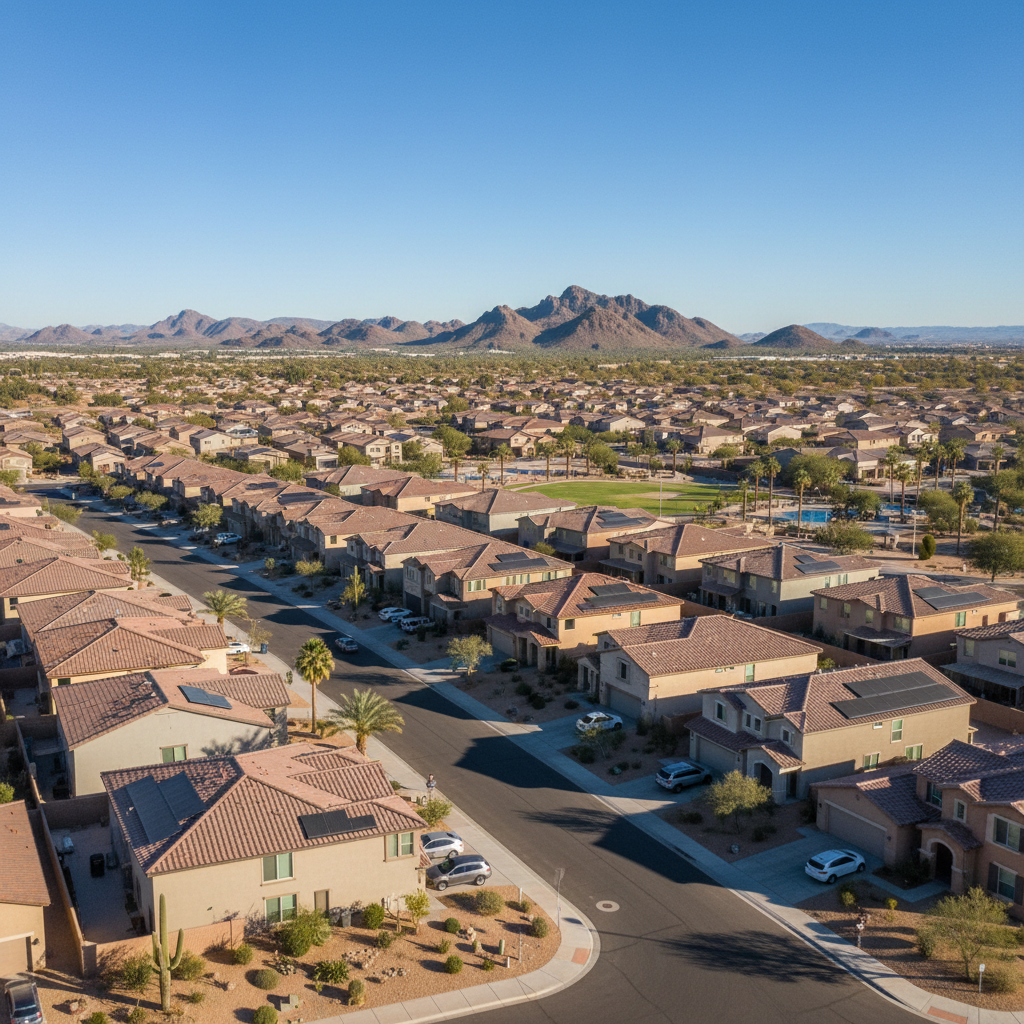
Suburban sprawl has long been part of Arizona’s growth story—and in 2025, the demand for single-family rentals (SFRs) is stronger than ever. In cities like Surprise, Queen Creek, and Maricopa, SFRs are providing space and amenities to families reluctant or unable to buy.
According to Roofstock’s latest data, Arizona is among the top five states for SFR portfolio expansion. Investors are drawn to stable tenants, low turnover, and markets where school quality and job access intersect. These suburban zones offer strong long-term rent growth and relatively lower maintenance than larger multifamily properties.
In-State Migration: Phoenix Leads, But Other Cities Rise
Arizona’s internal migration continues to fuel real estate demand. While Phoenix remains the primary engine—thanks to its job market, affordability (relative to coastal states), and lifestyle—other cities like Tucson, Prescott, and Sierra Vista are gaining momentum.
Developers are following population growth and building near tech parks, logistics corridors, and medical centers. Flagstaff and Sedona, while smaller, attract remote professionals and retirees, making them appealing for targeted development. Investors tracking in-state migration patterns are finding new opportunities in markets previously considered secondary.
Mixed-Use Developments & Urban Revitalization
Mixed-use developments are reshaping Arizona’s urban and suburban landscapes. In Phoenix’s Roosevelt Row and Tucson’s downtown core, walkable communities that combine housing, retail, and coworking space are seeing renewed investment.
While some developments face hurdles—such as permitting or infrastructure limits—demand is high among young professionals and remote workers seeking lifestyle-oriented neighborhoods. Mixed-use assets near light rail stations and cultural centers are commanding premium rents and strong occupancy. In the suburbs, developers are experimenting with micro-communities that blend residential, commercial, and recreational space.
Niche Assets on the Rise: Senior & Student Housing
Arizona is one of the top states for retirees—and that trend is only accelerating in 2025. The senior housing market, particularly in the Phoenix Valley and Green Valley region, is experiencing rising occupancy. Assisted living, memory care, and age-restricted communities are expanding quickly to meet the aging population’s needs.
At the same time, student housing is performing strongly in college towns like Tempe (Arizona State University) and Tucson (University of Arizona). Pre-leasing is above 90%, with students demanding modern, tech-equipped units and shared spaces. Developers focusing on quality, connectivity, and proximity to campus are seeing strong returns.
Risk Factors and Investment Cautions
Arizona offers many real estate opportunities, but it’s not without risks. Rising insurance premiums linked to wildfire and heat exposure are a growing concern, especially for rural and edge-of-desert properties. Water scarcity is also a long-term factor that developers and institutional investors are monitoring closely.
On the regulatory side, Arizona remains relatively favorable to landlords, but individual cities like Phoenix are beginning to discuss zoning reforms and potential tenant protections. Financing remains more expensive than pre-2022 levels, and underwriting standards are tight.
Conservative financial planning and a clear understanding of local environmental factors are essential for sustainable investment in the state.
Expert Insight: What the Analysts Say
“Arizona’s growth trajectory remains one of the most compelling in the country,” says Lauren Bellingham, senior economist at CBRE. “But local execution is critical. What works in Chandler may not work in Flagstaff, and demographic precision is what separates success from stagnation.”
Redfin’s 2025 Housing Trends report echoes this. It points to population growth, housing affordability, and infrastructure investment as central forces behind Arizona’s real estate momentum. Analysts emphasize the importance of reading micro-market signals and planning accordingly.
Strategic Diversification is Key in 2025
Arizona’s 2025 real estate outlook is a story of strategic opportunity. Multifamily investments continue to perform well in major metros. Industrial space is booming in logistics-heavy corridors. SFRs are thriving across the suburban fringe, while mixed-use and niche housing options are gaining momentum among aging and student populations.
Smart investors are leveraging Arizona’s unique combination of demographic expansion, business-friendly climate, and geographic advantage. Those who diversify across asset types and align with regional population flows are best positioned to succeed in a market that rewards adaptability and local insight.