- calendar_today August 13, 2025
In 2025, Arizona’s commercial real estate market is riding a new wave of momentum, backed by surging population growth, large-scale solar and semiconductor investments, and rapid industrial expansion. While national CRE trends remain cautious, Arizona is defying broader headwinds with fundamentals that favor logistics, multifamily housing, and green infrastructure.
Phoenix, one of the fastest-growing metro areas in the country, continues to lead the charge. But emerging markets like Tucson, Mesa, and Yuma are also experiencing increased investor attention, particularly in sectors aligned with the state’s strategic economic positioning between California, Texas, and Mexico.
Industrial Growth: Arizona’s New Economic Backbone
Industrial real estate is the crown jewel of Arizona’s commercial market in 2025. Vacancy rates across greater Phoenix remain below 4%, driven by relentless demand for distribution centers, advanced manufacturing, and cold storage facilities.
Major wins like the $40 billion TSMC chip manufacturing facility in north Phoenix are reshaping the landscape. The ripple effect of these megaprojects includes robust leasing activity in surrounding industrial parks, particularly in the West Valley, where land is more available and zoning is favorable for large-scale development.
According to JLL, over 15 million square feet of new industrial space is set to be delivered in Arizona this year, much of it pre-leased. Markets like Goodyear and Glendale have become magnets for logistics operators, third-party distributors, and e-commerce firms seeking strategic proximity to California without the regulatory overhead or high costs.
Office Market: Shifting Toward Suburban and Mixed-Use
Arizona’s office sector continues to evolve post-pandemic, with a strong tilt toward suburban and flex-office spaces. Downtown Phoenix is stabilizing, but it’s areas like Tempe, Chandler, and Scottsdale that are seeing the most leasing momentum, especially for medical, tech, and professional services.
The hybrid work trend has reduced the average square footage leased per employee, but high-growth companies are still seeking well-located, amenity-rich spaces. In 2025, the office vacancy rate in Phoenix hovers around 19%, though Class A suburban spaces are faring significantly better—closer to 13%.
Developers are repurposing underused office space into co-working hubs, live-work communities, and healthcare clinics. Arizona’s expanding senior population is also fueling growth in medical office buildings (MOBs), especially around retirement hubs in Sun City and Green Valley.
Retail Recovery: Experience and Convenience Lead
Retail real estate in Arizona is making a selective comeback in 2025, especially in lifestyle and convenience formats. Traditional indoor malls have struggled, but outdoor shopping centers, mixed-use plazas, and experiential retail have gained ground.
In Scottsdale and Tucson, high-income demographics are driving demand for luxury retail and upscale dining, while suburban nodes like Queen Creek and Surprise are attracting big-box tenants, grocery chains, and drive-thru food concepts. Arizona’s continued influx of new residents—over 100,000 in 2024 alone—is helping bolster retail foot traffic.
Retail spaces that combine dining, wellness, and entertainment are outperforming, particularly in walkable districts supported by newer multifamily developments. Phoenix’s Roosevelt Row and Tucson’s Fourth Avenue are examples of retail corridors thriving on mixed-use, arts-driven urban planning.
Multifamily Momentum: A Hotbed for Development
Arizona remains a top destination for multifamily investment in 2025. Rising home prices, limited housing inventory, and strong in-migration from California, Colorado, and the Midwest have made renting the most viable option for many residents.
According to Yardi Matrix, over 12,000 new units are projected to be completed in the Phoenix metro in 2025. However, demand is expected to keep pace, keeping occupancy rates above 94% and rent growth steady at 3–4% annually.
Build-to-rent (BTR) communities are also booming across the state. These single-family rental developments, popular in areas like Buckeye, Peoria, and Maricopa, cater to working families priced out of homeownership but looking for space and amenities.
Developers are increasingly integrating solar panels, EV charging, and water-efficient landscaping into multifamily projects, aligning with Arizona’s sustainability goals and utility incentives.
Solar Energy and Green Infrastructure: A Real Estate Catalyst
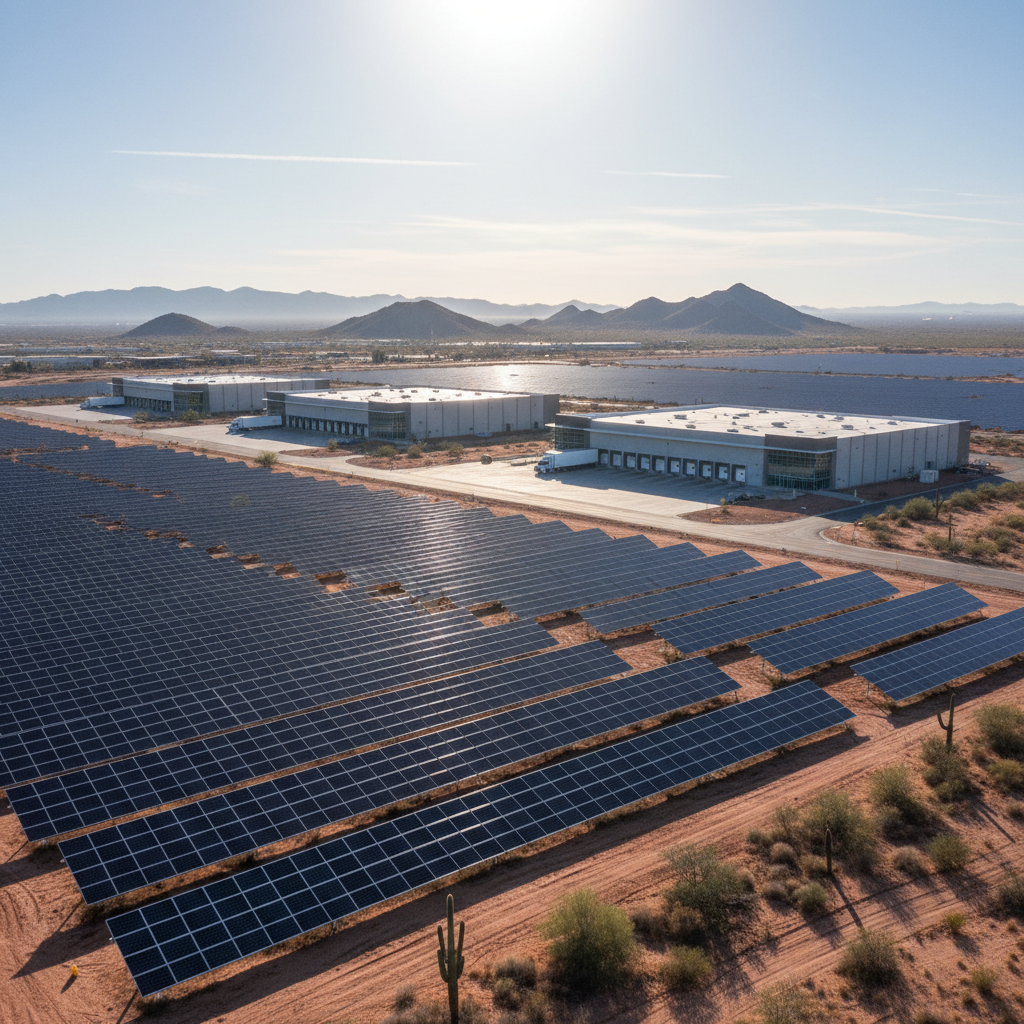
One of the defining trends shaping Arizona’s CRE market in 2025 is the acceleration of solar energy and sustainability-driven infrastructure. As one of the sunniest states in the U.S., Arizona is leveraging its geographic advantage with record investments in solar farms, battery storage, and green building.
Land near transmission lines in Pinal and La Paz counties has become a hot commodity for renewable energy developers, pushing up industrial land values. Commercial buildings—especially warehouses and office parks—are adding rooftop solar as a way to reduce operating costs and attract ESG-conscious tenants.
Municipalities including Tempe and Flagstaff have adopted sustainability zoning overlays, fast-tracking approvals for green-certified developments and offering tax credits for LEED or Net-Zero construction. These measures are making Arizona an increasingly attractive destination for CRE investors focused on long-term climate resilience.
Challenges: Water Scarcity and Land Constraints
Despite the momentum, Arizona’s commercial real estate sector faces critical challenges—chief among them, water.
With the Colorado River crisis still unfolding, regulatory uncertainties around water usage are beginning to influence land valuations, particularly in agriculture-heavy areas of Pinal and Yuma counties. Developers are also facing tighter water usage audits and incentives to integrate conservation measures into project designs.
Additionally, land prices in high-growth metros like Phoenix and Scottsdale are escalating, putting pressure on margins for multifamily and mixed-use projects. Supply chain issues and construction labor shortages—though easing—continue to delay some project deliveries and inflate costs.
Investor Outlook: Regional Diversification and Strategic Plays
Investors in 2025 are diversifying their Arizona strategies beyond Phoenix. Secondary cities like Flagstaff, Prescott, and Sierra Vista are gaining traction for their affordability, university presence, and tourism economies. Tucson, with its growing defense sector and biosciences cluster, is attracting medical office and multifamily development.
Cap rates remain compressed in core Phoenix submarkets but are more favorable in tertiary zones and repurposed retail assets. Value-add opportunities—such as converting older office parks to flex or mixed-use—are attracting out-of-state capital, especially from California and Texas.
International investors, including funds from Canada and Europe, are also increasingly active, drawn by Arizona’s stable regulatory climate, energy transition incentives, and strong population fundamentals.
Closing Snapshot
Arizona’s 2025 commercial real estate recovery is shaped by its unique blend of affordability, climate advantage, and regional growth. From semiconductor manufacturing to solar energy, the state is laying the groundwork for a CRE market that not only rebounds—but transforms. With strong fundamentals in industrial and multifamily, and renewed interest in retail and office adaptation, Arizona’s real estate market is proving that the desert is anything but dry for investors.